

Controls

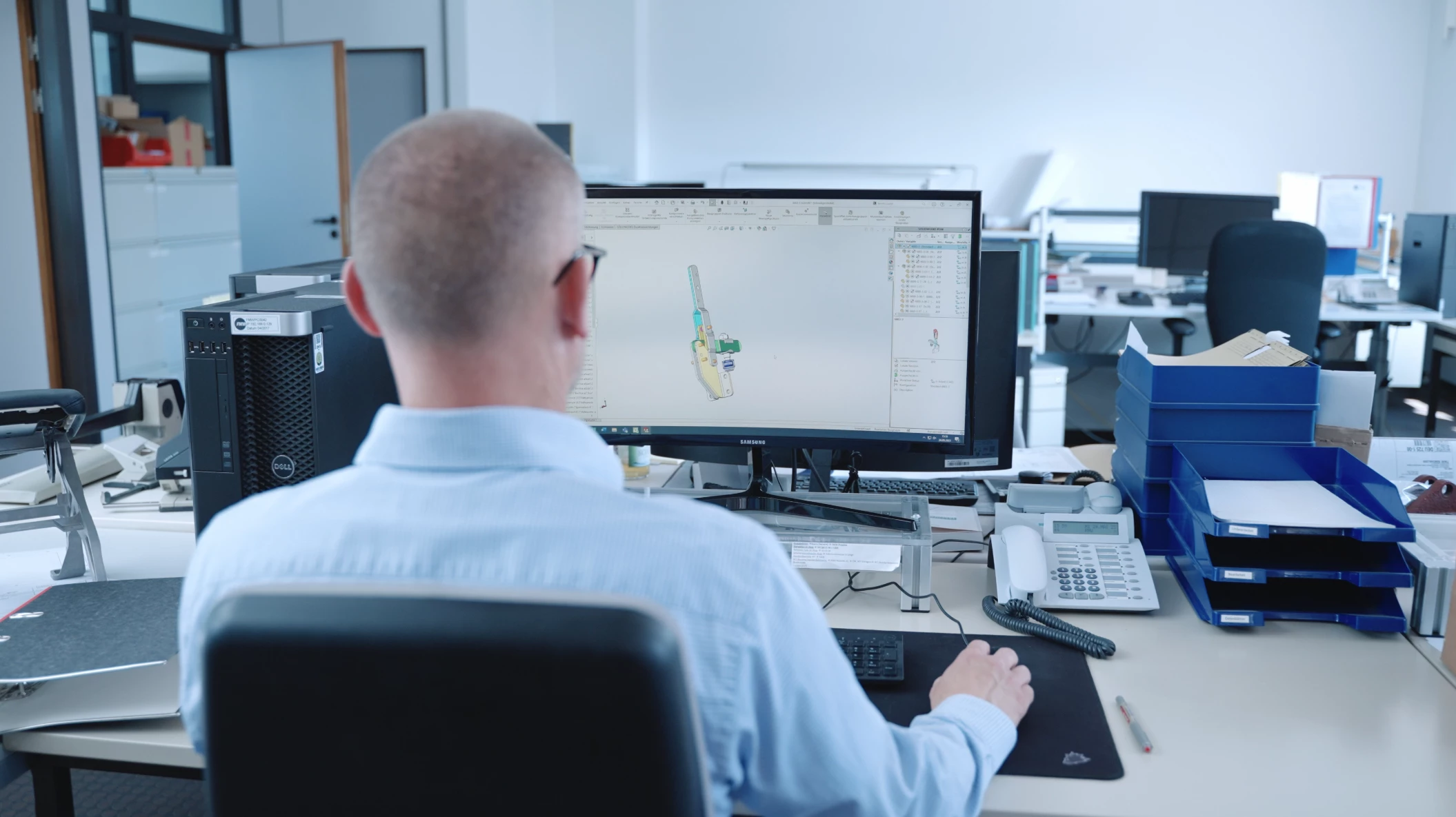
FMW Friedrich Basic Control PT23
Pressure-Time Control
Our in-house-developed pressure-time control combines modern ease of operation with high process reliability, creating ideal conditions for precise industrial riveting processes.
As a versatile control system for riveting machines, it supports cost-effective production and can be flexibly integrated into a wide range of production environments.
The FMW Friedrich Basic Control PT23 is compatible with all base riveting machines.
Customer-specific signals and additional functions can be integrated upon request.
Retrofit:
Backward compatibility with older FMW Friedrich riveting machines
- Modern, robust 4.3-inch touch display for industrial applications
- Integrated safety PLC
- Access restriction via key switch
- USB interface for software updates
- OPC UA interface for machine status
- Additional controls directly on the display
- Riveting controlled via pressure and time or a mechanical stop
- Up to 10 different riveting points as standard; expandable to 100 riveting points
- Part counter for each riveting point
Examples of Start Methods:
- Safe two-hand control
- Foot switch
- Slide unit position sensor confirming the riveting position
Intuitive Menu Navigation and Program Functions:
- Setup and management of riveting points
- Visual real-time display of the riveting time
- Control of slide units with one or two riveting points, indexing cylinders and lifting stations
- Simultaneous display of target and actual process values
- Setup mode with teach-in function
- Control of Riveting Power Levels for compatible riveting machines
User Support:
- Help function directly in the user menu
- Language switching between German and English
- Additional languages available upon request
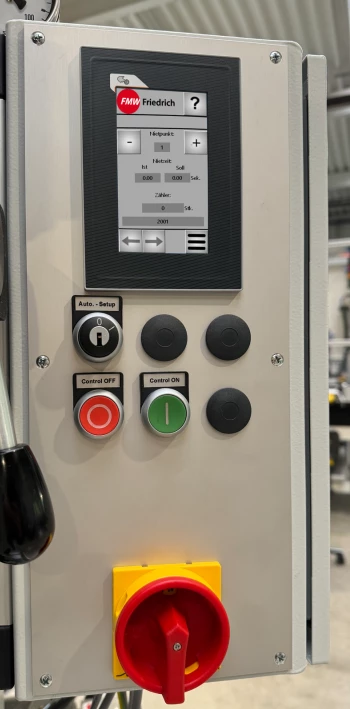
FMW Friedrich Nietcontrol 3
Process Monitoring
The third generation of our FMW Nietcontrol software, developed by our specialists, meets all requirements for parameterization and modern operating concepts.
The proven operating principle, combined with an informative and clearly structured user interface, perfectly complements our riveting technologies.
The FMW Friedrich Nietcontrol 3 is compatible with all base riveting machines and base riveting units.
Customer-specific signals and additional functions can be integrated upon request.
Retrofit:
Backward compatibility with older FMW Friedrich riveting machines and riveting units equipped with Nietcontrol
- High-resolution, robust 5-inch multi-touch display for industrial applications; optionally available as a separate display with or without housing
- Safety PLC or safety relay
- Access restriction via key switch
- USB interface for loading and backing up riveting programs and for software updates
- TCP socket connection for QA data transmission
- Additional controls directly on the display
- Internal EtherCAT communication
- Riveting process termination based on seven different control variables
- Up to 63 different riveting points can be parameterized as standard; optionally expandable to 255
- Communication with a higher-level PLC
- Part counter for each riveting point
- Classification for complex tolerance combinations with 10 classes of 30 riveting points each
- Riveting tool positioning
- Variable riveting motor speed for each riveting point
- Suitable for controlling roll-forming processes
Examples of Start Methods:
- Safe two-hand control
- Foot switch
- Slide unit position sensor confirming the riveting position
- Higher-level PLC
Intuitive Menu Navigation and Program Functions:
- Setup and management of riveting points
- Visual real-time display of process monitoring
- Control of slide units with one or two riveting points, indexing cylinders and lifting stations
- Simultaneous display of target and actual process values
- Setup mode with teach-in function
- Control of Riveting Power Levels for compatible riveting machines
User Support:
- Help function directly in the user menu
- Language switching between German and English
- Additional languages available upon request
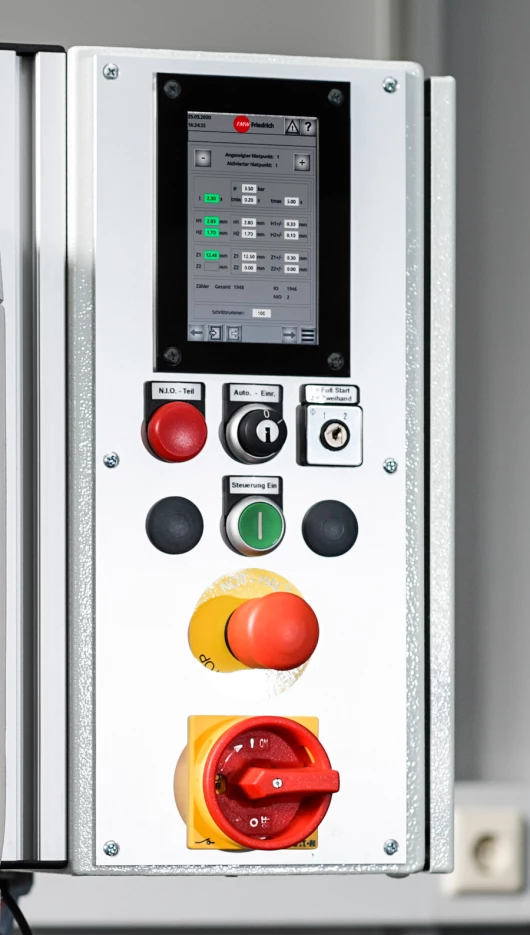
FMW CNC Machine Control
Automation Made by FMW Friedrich
Our CNC machine control offers a wide range of applications in both FMW Friedrich CNC riveting machines and our assembly systems. A state-of-the-art operating concept, highly flexible programming and continuous development make it a central element of our production systems. Customer-specific functions and signals can be implemented at any time.
Retrofit:
Backward compatibility with older FMW Friedrich CNC riveting machines
- High-resolution, robust 18.5-inch multi-touch display for industrial applications
- Safety PLC
- Access restriction via key switch
- USB interface for loading and backing up riveting programs or connecting external input devices
- OPC UA interface for machine status
- Additional controls directly on the display
- Internal EtherCAT communication
- Riveting process termination based on seven different control variables
- Up to 200 riveting programs with 30 riveting points each
- Communication with a higher-level PLC
- Part counter for each assembly
- Classification for complex tolerance combinations with 10 classes of 30 riveting points each
- Riveting tool positioning
- Variable riveting motor speed for each riveting point
- Suitable for controlling roll-forming processes
Examples of Start Methods:
- Safe two-hand control
- Clearing the safety light curtain
- Closed safety door
- Higher-level PLC
Intuitive Menu Navigation and Program Functions:
- Setup and management of riveting points
- Positioning and control of the CNC axes
- Control of additional processing stations
- Graphical representation of the riveting program
- Visual real-time display of process monitoring
- All riveting process parameters can be set in a single window
- Setup mode with teach-in function
- Control of Riveting Power Levels for compatible riveting machines
User Support:
- Help function directly in the user menu
- Language switching between German and English
- Additional languages available upon request
- Remote service
- Production data acquisition interfaces
- Machine and system networking
- Data logging
- Support for open-source platforms and other systems
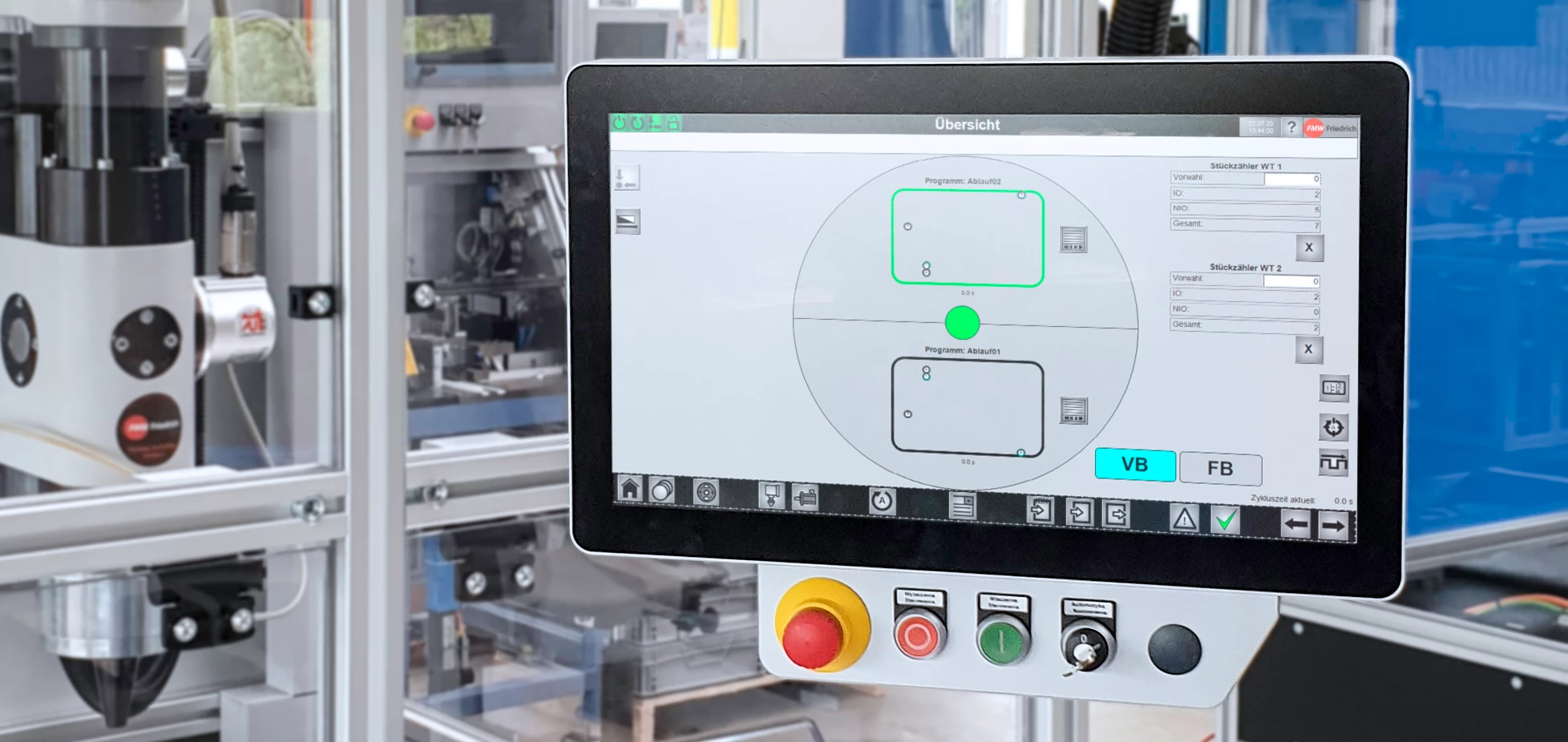
FMW-Pick-by-Vision
The optional FMW Pick-by-Vision system adds another modern and helpful feature to the FMW CNC machine control.
In the event of a loading or riveting error, the machine display visually highlights the exact areas where operator action is required.
This minimizes loading and rework times and helps reduce costs.
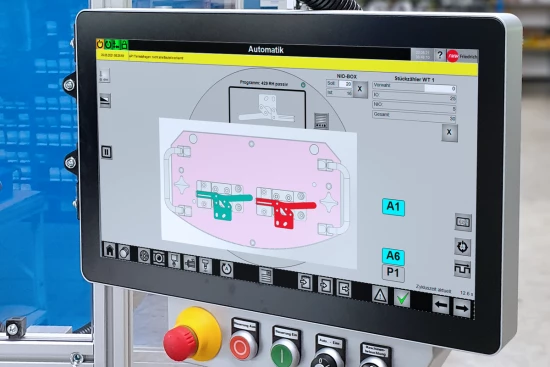
Example: A raw-dimension error causes one of the components to be highlighted in red.
FMW Friedrich QAPV
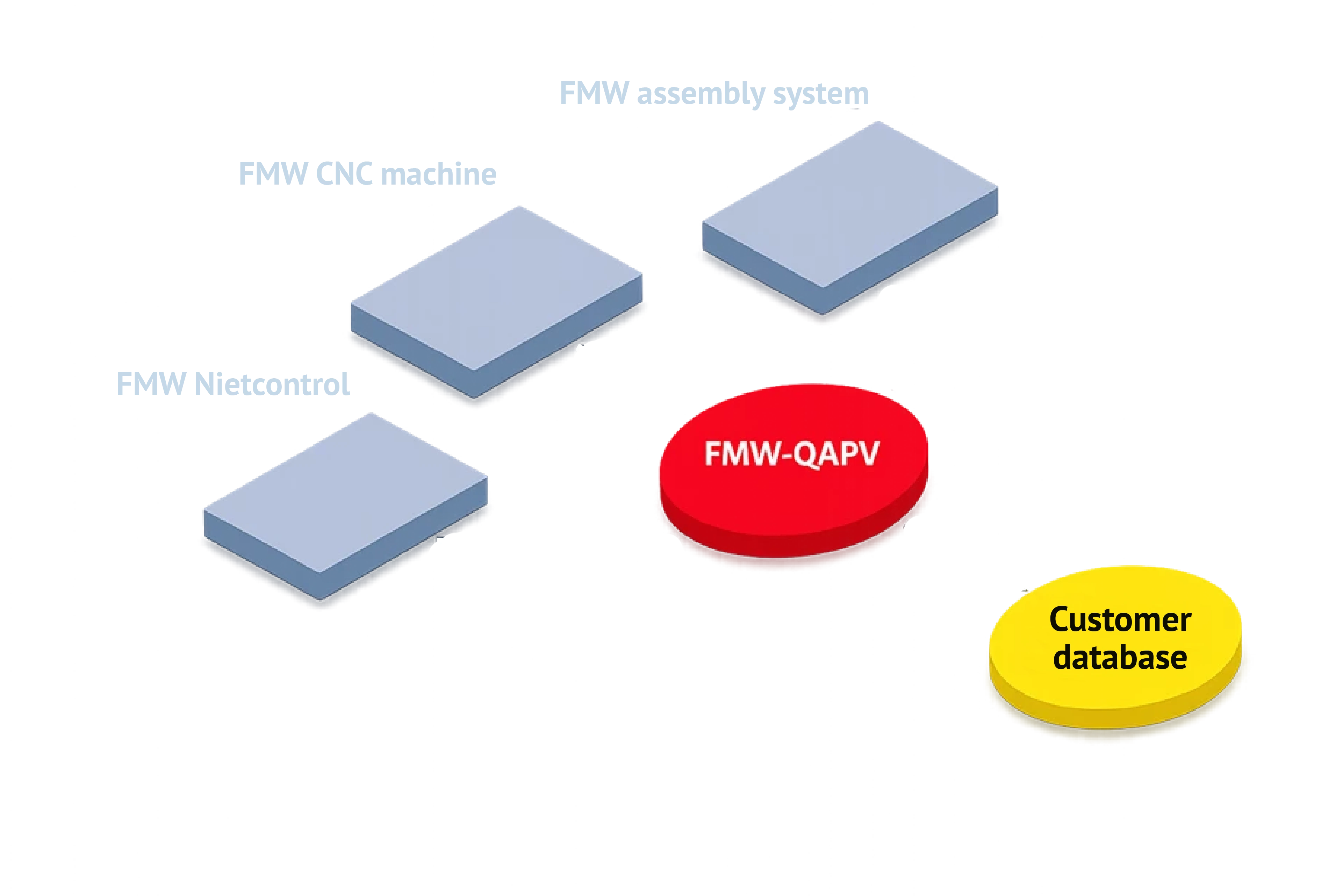
The FMW Friedrich QAPV software – Quality Assurance and Process Visualization – was developed in collaboration with our customers for the acquisition, archiving and visualization of process data.
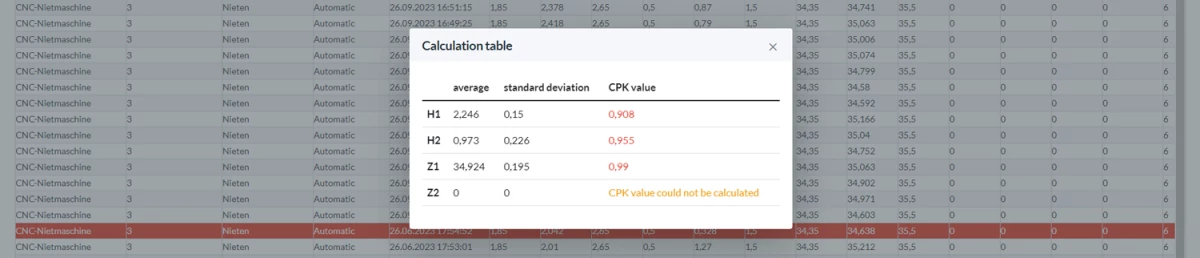
Important key figures such as Cpk and Cmk are presented graphically and can be made available to external systems via an interface when required. Archived data can be re-imported at a later date.
Riveting Process Monitoring
FMW Friedrich
Quality Assurance for the Riveted Joint
With the FMW Nietcontrol
The FMW Nietcontrol provides reliable and reproducible monitoring of the entire riveting process. Deviations are detected immediately, documented and clearly localized.
The patented measuring method records all quality-relevant parameters in real time:
- Distance
- Time
- Rivet length
- Rivet projection
- Closing head height
This ensures complete quality assurance, minimizes operator effort and simultaneously increases both process reliability and the operational safety of your riveting systems.
In combination with the FMW Friedrich QAPV software, the measured values provided by the control system can be continuously recorded and used to calculate machine capability and process capability.
Distance and Time as Reliable Process Values
Reproducible and Precise
For reliable quality assurance, the FMW Nietcontrol also monitors the material properties of the rivet. Instead of relying on complex force measurement, the system precisely records distance and time.
These reproducible measured values enable reliable detection of material deviations, complete documentation and a high level of process reliability.
Since accurately determining force is virtually impossible in highly dynamic riveting processes, FMW Friedrich verifies the material properties using “hard” parameters.
Reproducible parameters such as distance and time can be measured very accurately and reliably documented. They are therefore ideally suited for quality assurance.
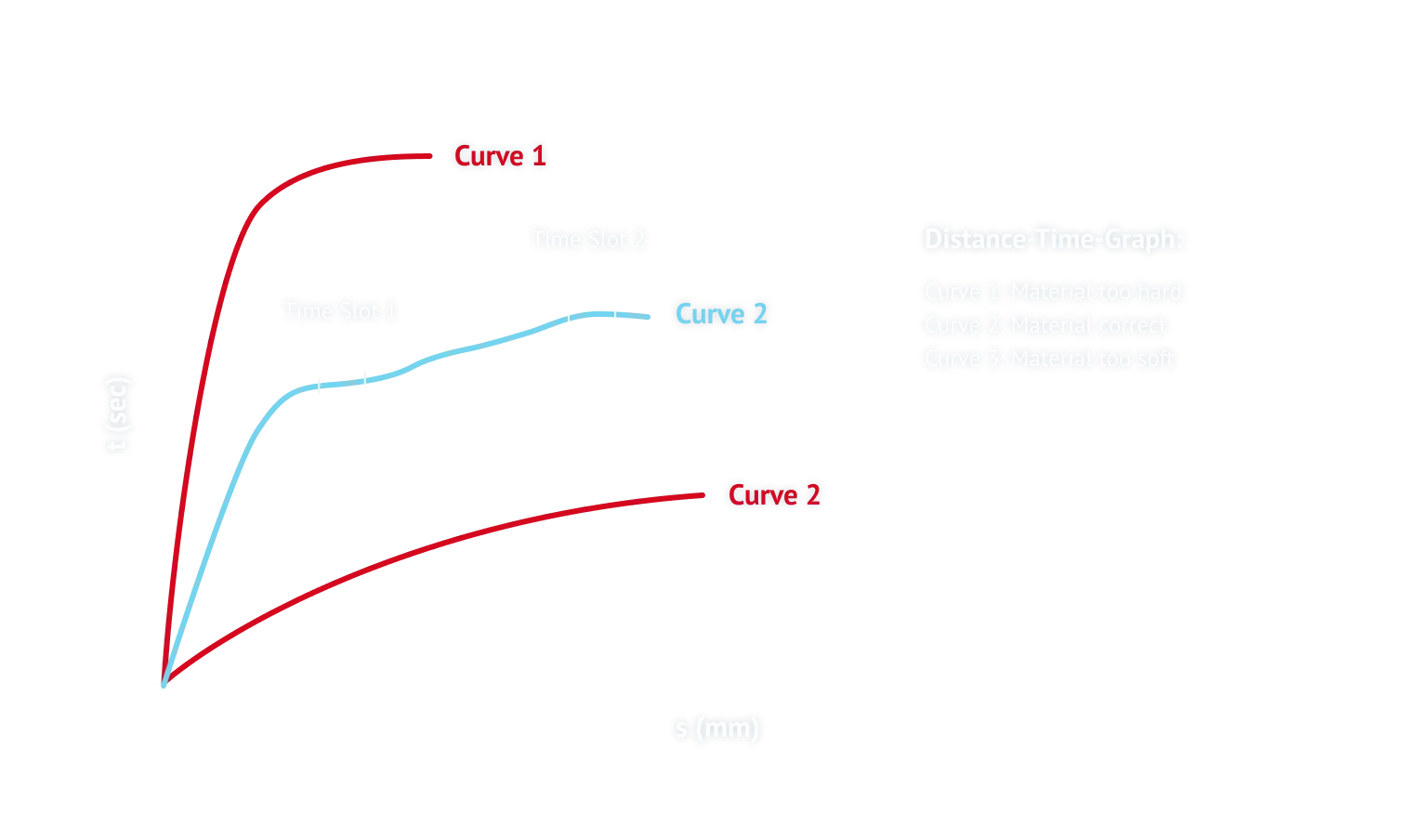
The travel of the riveting spindle is measured and recorded by sensors with hundredth-of-a-millimeter precision. The FMW Nietcontrol software divides the time axis into millisecond intervals.
In theory, it would be possible to record a continuous curve using any number of time windows. In practice, however, a single time window is sufficient.
Riveting curve as a function of distance and time
The FMW Nietcontrol can combine length measurement and projection measurement in a single system. This reliably monitors both the rivet geometry and the presence of all components. Once the defined finished dimension has been reached, the riveting process is automatically completed.
The Length Measuring System
FMW Friedrich Z-Axis
The length of the unriveted rivet shank (Z1) is measured. The length sensor is positioned directly on the riveting spindle and transmits the measured values to the FMW Nietcontrol at millisecond intervals. Measurements are taken continuously during the riveting process. At the same time, programmable time windows are used to verify whether the material properties meet the specified requirements.
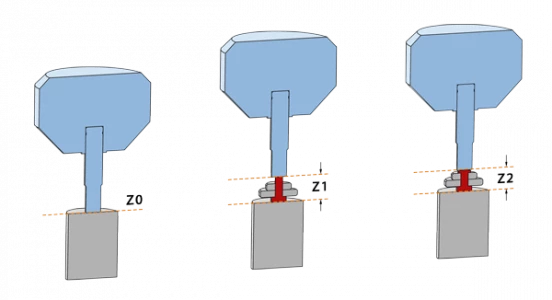
The FMW Nietcontrol moves the riveting spindle onto the rivet using low measuring pressure and with the riveting die in a vertical position. This prevents the rivet from being deformed during measurement.
If the length of the unriveted rivet (Z1) is outside the specified tolerance, an NOK message is generated. Since the rivet shank has not been deformed during measurement, it can be replaced.
If the length (Z1) is within the specified tolerance, the riveting motor is activated at the programmed riveting pressure and the rivet is formed to the finished dimension (Z2). If the programmed finished dimension (Z2) is within tolerance and the riveting process remains within the specified time window, the riveted joint is classified as OK. The riveting spindle retracts and the riveting die is returned to its vertical position.
If the measured finished dimension is outside the specified tolerance or the riveting process falls outside the defined time window, an NOK message is generated.
The Projection Measuring System
FMW Friedrich H-Axis
The projection of the unriveted rivet shank (H1) is measured. For projection measurement, the measuring device is positioned directly on the spring-loaded hold-down device.
For calibration, the hold-down measuring system is compressed against a flat surface. The H0 plane is reached when the measuring insert and the riveting die are on the same plane. When the riveting spindle retracts, the measuring insert is released and the riveting die rests behind the hold-down device. The measured projection value is shown on the display.
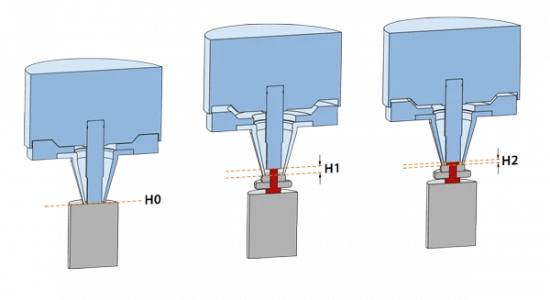
The FMW Nietcontrol moves the riveting spindle onto the rivet using low measuring pressure and with the riveting die in a vertical position. This prevents the rivet from being deformed during measurement.
As the riveting spindle advances, the hold-down measuring system is preloaded until the riveting die contacts the rivet. Measurement (H1) is performed at low pressure so that the rivet shank is not deformed.
At the same time, the projection measurement verifies that all components of the riveted joint are present. If a component is missing, an NOK message is generated. The missing component can then be added. In this way, projection measurement helps prevent incorrect riveting operations.
If the projection of the unriveted rivet is within the specified tolerance, the riveting motor is activated at the programmed riveting pressure and the rivet is formed to the finished dimension (H2).
If the specified finished dimension – closing head height H2 – is reached and the riveting process remains within the specified time window, the riveted joint is classified as OK. The riveting spindle retracts and the riveting die is returned to its vertical position.
If the measured finished dimension (H2) is outside the specified tolerance or the riveting curve falls outside the defined time window, an NOK message is generated.
Combining the Length and Projection Measuring Systems
Z- and H-Axes Working Together
A machine can be equipped with both measuring systems. This allows the rivet length or projection to be measured while simultaneously verifying the presence of all components. Once the finished dimension (Z2 or H2) has been reached, the riveting process is completed.
Quality Assurance and Process Visualization (QAPV)
Software
The QAPV software is a web-based application for FMW Friedrich riveting machines and riveting units equipped with a measuring system. It was specifically developed for archiving, evaluating and visualizing process data from FMW Friedrich machines and systems.
The recorded data can be displayed, filtered, exported and archived.
QAPV can run directly on a DIN-rail PC in the control cabinet or on a suitable external PC, for example in the production supervisor’s office. The data connection to the machine PLC or PLCs is established via an Ethernet network using TCP/IP.
When the data connection between the QAPV software and the PLC is active, the process values recorded during operation are read from the PLC after each production step and stored in an SQL database.
The stored data can be displayed and evaluated from almost any terminal device connected to the QAPV computer via an Ethernet network and equipped with an up-to-date web browser.
Access to the QAPV application’s user interface can be restricted through configurable user management.
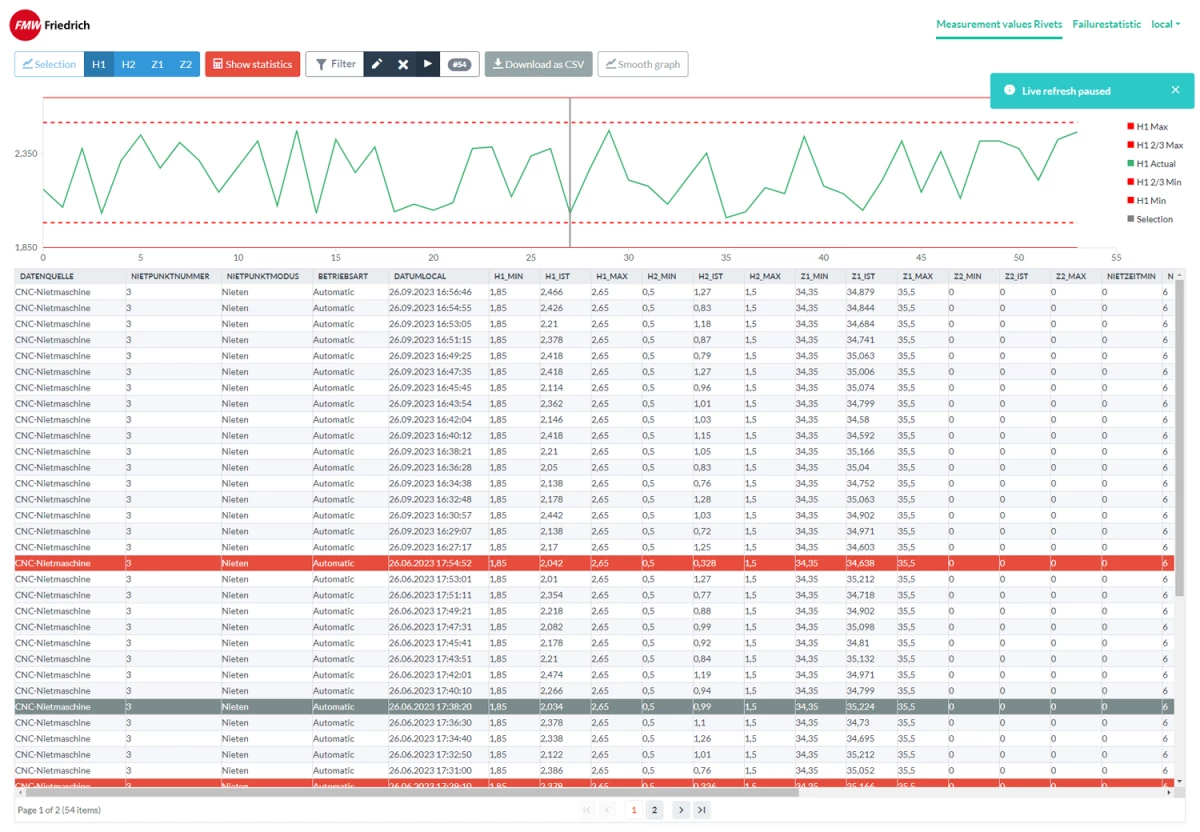
The main screen displays the riveting process values recorded by all machines. The values are statistically processed and presented graphically when they meet the selected filter criteria. When new datasets matching the current filter criteria are received from the connected machine controls, the displays are updated automatically.
The graph shows the recorded minimum, actual and maximum values for the axis selected using the statistics buttons. The minimum and maximum limits are displayed as red curves, while the actual values are displayed as a green curve.
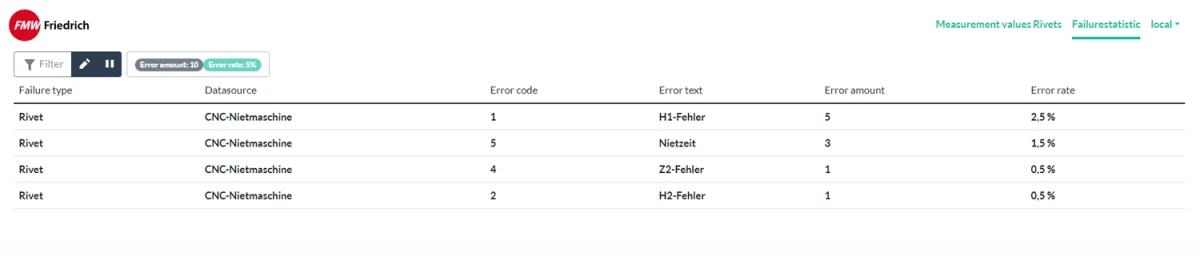
An integrated error statistics function provides a statistical summary of process errors.
Archiving Process Values
To maintain SQL database performance during continuous operation, older data is automatically transferred by the QAPV software to a file-based SQLite database. This process runs automatically in the background.
Thanks to the open SQLite file format, customers can analyze the resulting archive files themselves or view them using an archive viewer.
The archiving schedule and the amount of data archived are variable and depend on the utilization of the SQL database.
